One Line Draw Walkthrough & Level Guide
How to beat One Line Draw — Not officially published; many levels of progressively increasing difficulty. · Updated
Overview
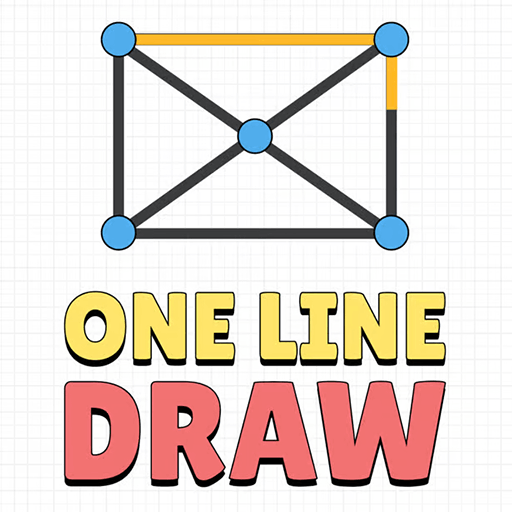
One Line Draw is a one-stroke tracing puzzle: your job is to cover every line in a figure exactly once, in a single continuous motion, without lifting your finger or going over any segment twice. There are no published per-level answers, and you do not need them. Every board is built around one piece of math - the Euler path rule - so once you learn to read a puzzle you can solve any level yourself. This walkthrough explains the general method that works from the very first shape to the hardest grids, organized by the kind of board you will face.
How One Line Draw levels work
A linear sequence of one-stroke puzzle boards that grow from simple shapes to dense grids with more junctions and dead ends. (Not officially published; many levels of progressively increasing difficulty.).
Stage-by-stage strategy
The odd-vertex rule (works on every level)
Before drawing, look at each dot or corner and count how many lines meet there. Points with an even number of lines are pass-through points; points with an odd number are where a stroke must begin or end. A figure is solvable in one line only when it has exactly zero or two odd points. With zero odd points you can start anywhere and will finish where you began; with two, you must start on one odd point and finish on the other - starting anywhere else strands a line. Every level in the game is designed to be solvable, so use this rule to choose your starting point, not to test whether the level is possible.
Early boards: simple shapes
The first levels are single shapes - triangles, squares, stars, and the classic envelope. Many have all-even points, so you can start at any corner and simply keep moving, taking care never to leave a segment behind you with no way back. When you meet envelope-style shapes that have two odd corners, begin at one of those odd corners. Trace these slowly and deliberately; the habit of always leaving yourself an exit is what carries you through the harder boards later.
Mid-game: multiple junctions and branches
As boards grow they sprout branches and internal crossings, and the trap is greedily filling one region while cutting yourself off from another. Two habits fix this. First, deal with any dead-end spur (a line connected at only one end) the moment you pass its junction, because you can enter and leave it only once. Second, when a junction offers several exits, prefer the exit that does not disconnect the rest of the figure - keep every remaining line reachable from where you are.
Advanced grids and getting unstuck
Dense lattice levels look intimidating but obey the same rule: find the at-most-two odd points and start there. If you keep trapping yourself, trace the exact same route in reverse, or start from the opposite side - a path that dead-ends going forward often works backward. When nothing lands, reset the board (there is no penalty) and re-count the odd corners before your next attempt. Patience beats speed: with no timer, plan the full loop with your eyes before you commit your finger.
Tips to beat One Line Draw faster
- Count the lines meeting at each dot: points with an odd number are where your stroke must start or end.
- If every point has an even number of lines, you can begin anywhere - and you will finish back at your starting dot.
- Trace the whole route with your eyes before touching the screen; committing too early is the most common way to get boxed in.
- Handle dead-end spurs and narrow branches the instant you reach their junction, since you only get one pass through each.
- Stuck on a board? Try the exact same path in reverse, or start from the opposite corner - it often unlocks the solution.
- There is no timer on the puzzles, so treat each one as a logic problem and take your time.
One Line Draw walkthrough FAQ
Are there official answers for each level?
No. Unico Studio does not publish per-level solutions, and reputable guides do not either. Rather than memorize answers, use the odd-vertex method - it lets you solve any board the game presents.
How do I know where to start a level?
Count the lines meeting at each dot. If two dots have an odd count, start at one of them and end at the other. If every dot is even, you can start anywhere and will end back at your start.
Is every level really possible?
Yes. The game only ships boards that have a valid one-stroke path, so a failed attempt is a routing mistake, not an impossible puzzle - reset and re-plan.
More free games