Hidden Object Games — Free Online Hidden Object & Spot the Difference, No Download
Searching for hidden object games almost always turns up two different genres wearing the same label, and picking the wrong one is the fastest way to a disappointing five minutes. A true hidden object game gives you one dense, illustrated scene and a list of things concealed inside it — a key behind a curtain, a spoon lying along the edge of a table — and you click them off one at a time. A spot-the-difference game gives you two pictures that look identical and asks you to find the places where they are not. Both reward the same skill, a patient eye, but they feel nothing alike: one is a slow hunt through a single painting, the other is a side-by-side comparison against a clock. Everything on this page is labelled SEARCH A SCENE or TWO PICTURES so you can tell at a glance which you are getting, and every one plays free in a browser tab with no download, no install and no account.
Games in this genre
 Hidden Objects Lost Island 2 →
 Looking for Aliens Collector's Edition →
 Dark Strokes: Sins of the Fathers →
 Lost Things →
 Hidden Object Emily's Case →
 Clean Before Your Wife Returns - Hidden Object →
 Hidden Objects Pirate Treasure →
 Find the Pets →
 House of 1000 Doors: Evil Inside →
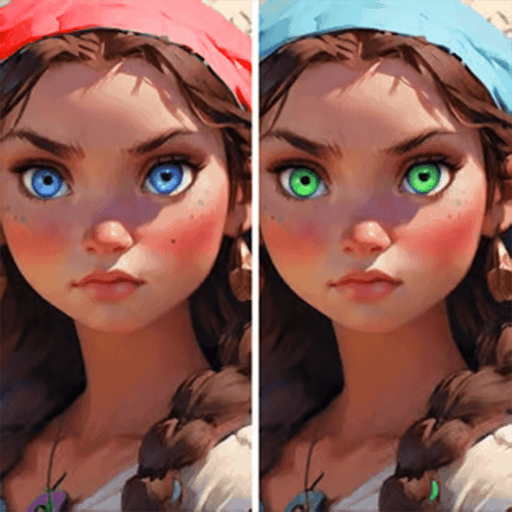 Spot the Differences →
 Crime Detective - Spot Differences →
 The Kitchen - Spot the differences →
 Robot Bar - Find the differences →
 Italian Brainrot: Find the Difference →
Famous games that defined the genre
Where’s Wally? / Where’s Waldo? — Martin Handford’s illustrated search books, first published in 1987, are the ancestor of the whole format: one enormously crowded drawing, one target to find in it, and no instructions needed. They are books rather than games and we do not host them. Play a crowd-scene hunt here: Find the Pets →
I Spy — Scholastic’s I Spy series pairs photographed collections of small objects with rhyming riddles naming what to find — the same loop as a hidden object game, printed on a page. Also books, not something we host. Play a scene search here: Hidden Objects Lost Island 2 →
Mystery Case Files — The Big Fish Games series that turned hidden object into a mass-market PC genre. The first entry, Huntsville, arrived in 2005 and the franchise has run to dozens of sequels since. It is a commercial series and we do not host it. Play a detective scene search: Dark Strokes →
Hidden Folks — A hand-drawn, black-and-white hidden object game from 2017 in which the whole scene is animated and interactive — you poke at tents and bushes to uncover what is behind them. It is a paid title on Steam, mobile and Switch, not a free browser game, and we do not host it. Play an unhurried hunt instead: Lost Things →
Hidden object vs spot the difference
The hidden object format descends from illustrated search books and from the casual-PC boom of the mid-2000s: one richly detailed scene, a named list of objects somewhere in it, and usually a light story threading the scenes together. Difficulty comes from camouflage — objects are scaled oddly, rotated, tucked behind other objects or coloured to match what they sit on. The spot-the-difference format is a comparison task instead: two copies of the same artwork, a handful of deliberate edits between them, and a penalty for clicking where nothing changed. Because there is no object list, there is nothing to read and nothing to interpret, which is why these levels run short and stack up quickly. On this page Lost Island 2, Looking for Aliens, Dark Strokes, Lost Things, Emily’s Case, Pirate Treasure, Clean Before Your Wife Returns, Find the Pets and House of 1000 Doors are the scene searches. Spot the Differences, Crime Detective, The Kitchen, Robot Bar and Italian Brainrot: Find the Difference are the picture comparisons.
How to find things faster in either format
In a scene search, stop darting. Sweep the picture in bands — left to right across the top third, then the middle, then the bottom — because the eye skips over anything it has not deliberately passed across. Hunt silhouettes rather than whole objects: most items are partly covered, so you are looking for a handle, a corner or a curve, not the complete thing. Edges, frames and the darkest corners of a scene hide more than the busy middle does, which is where attention naturally lands. In a comparison round the equivalent habit is to split both images into quadrants and clear one quadrant in both pictures before moving on, instead of scanning the whole frame twice. Check the borders and the background last-but-not-never — removed or recoloured background details are the classic late find. And watch what a wrong click costs you, because in several of these games it is a life or a chunk of the timer rather than nothing at all.
Timed or relaxed, and which screen to use
If you want pressure, take Crime Detective - Spot Differences, which runs its cases against the clock, or Hidden Objects Pirate Treasure, where a wrong tap costs you time directly. Spot the Differences gives you three lives per level plus a timer and a hint button for when you are genuinely stuck; The Kitchen and Robot Bar both cap how many mistakes you are allowed before the round ends. If you would rather not be rushed at all, Lost Things is built for exactly that — a deliberately slow, no-hurry hunt across large illustrated landscapes — and Find the Fish, which we also host, states outright that it can be played with no timer. On screens: almost everything collected here is a landscape build, so a laptop, a desktop or a phone turned sideways suits them best. Lost Things is the exception and is built portrait, which makes it the one to reach for on a phone held upright.
Hidden Object Games — Free Online Hidden Object & Spot the Difference, No Download — FAQ
What is a hidden object game?
A game that shows you one densely illustrated scene and asks you to find specific things concealed inside it, usually from a named list. Items are rotated, shrunk, partly covered or coloured to blend into what they sit on, so the skill is patient looking rather than reflexes. Most add a light story and a few mini-games between scenes.
What is the difference between hidden object and spot the difference?
A hidden object game gives you one picture and a list of things hidden in it. A spot-the-difference game gives you two pictures that look the same and asks where they differ, with no list to work from. They reward the same patience but play very differently, which is why every game on this page is tagged SEARCH A SCENE or TWO PICTURES.
Are these hidden object games free, and do I need to download anything?
They are free and there is nothing to download. Every game on this page runs in your browser on this site — no install, no account, no waiting on lives.
Can I play Hidden Folks, Mystery Case Files or June’s Journey here?
No. Those are commercial releases and we do not host them. What this page collects is free browser games built on the same mechanics: Lost Island 2, Emily’s Case and Dark Strokes for the story-driven scene hunts, House of 1000 Doors for the longer puzzle-adventure version, and Lost Things if what you wanted was the unhurried hunt without a timer.
Are there hidden object games with no timer?
Yes. Lost Things is built around exactly that — large illustrated landscapes with nothing rushing you — and Find the Fish, which we also host, can be played without a timer as well. On the other side, Pirate Treasure, Crime Detective and Clean Before Your Wife Returns all put a clock on you deliberately.
Do these work on a phone?
They run on a phone, but almost all of them are landscape builds, so they are more comfortable on a laptop or with the phone turned sideways — the scenes are wide and the hidden details are small. Lost Things is the exception: it is a portrait build and fits a phone held upright.
How do I get better at spotting hidden objects?
Sweep the picture in bands instead of darting around it, and look for parts of objects — a handle, a rim, a corner — rather than the whole shape, since most items are partly covered. Edges, frames and dark corners hide more than the busy centre does. In two-picture rounds, clear one quadrant in both images before moving to the next instead of scanning the whole frame repeatedly.